

Canceled Program Power Rankings
What Major Defense Acquisition Programs Will Meet The White House Woodchipper

The White House means business – and they’re coming for the Pentagon’s weapons systems. On April 9th, POTUS directed SECDEF to review all major defense acquisition programs (MDAPs), and cancel some.
Spanning decades, birthing whole bureaucracies of their own, and expending many billions of taxpayer dollars, MDAPs are at the core of the Pentagon’s procurement culture. They are a source of great expense, but they also provide America’s warfighters unmatched capability. Some must be canceled. Others must survive, at least until battlefield contact.
This piece will look first at the orders SECDEF received 30 days ago – he has 60 days left to recommend programs to OMB. Then I will rack and stack programs. While the “power rankings” I offer are subjective, I’ll share lots of hard numbers for each program on cost & schedule overrun, budget changes, political and media attention, independent oversight, and opportunity cost.
This Piece’s Roadmap
Executive Order: Cancel Some DoD Programs Within 90 Days
30 days down. 60 to go
Cost & Schedule Projections Are Always Wrong
Analytical Approach: What Metrics do We Have?
Power Rankings: What Programs Will Get Cancelled
Survivors Under Scrutiny
Air & Space Force Deep Dive
Army Deep Dive
Navy & Joint Deep Dive
Conclusion – What History Will Remember
The Pentagon’s “Unsubscribe” Button

On April 9th, POTUS released a flurry of executive orders aimed at revitalizing America’s defense industrial base. One was on shipbuilding, another on foreign military sales, and a third on defense acquisition itself. Core to the defense acquisition reform order: review all underperforming programs —> recommend some cancellations. Here’s the exact language:
(i) any program more than 15 percent behind schedule based on the current Acquisition Program Baseline (APB), 15 percent over cost based on the current APB, unable to meet any key performance parameters, or unaligned with the Secretary of Defense’s mission priorities, will be considered for potential cancellation. The Secretary of Defense shall submit the potential cancellation list to the Director of the Office of Management and Budget (OMB) for future budget determinations.
With speed and expense as rightful indicators of program underperformance, anything 15% over budget or behind on schedule will be reviewed. I’ll analyze each program with 11 indicators of cancellation, of which cost and schedule will be the two most important.
Program Budgets & Schedules are Always Wrong
When a military service sets out to build a new weapon, they plan decades ahead. The write down a schedule, draft a budget, and put both through endless reviews before ever designing or building the weapon.
Imagine if a squad of marines preparing to take a hill acted in this way. They would write a detailed plan to take the hill, circulating it to every member of the squad for a few hours. They could each review it, adding their opinion, and arguing that various defensive points are easier or harder to attack from different angles, or with different tactics. Each of the marines, holding their positions beneath the hill, looks at their target from a different angle. The guy with the mortar and the guy with the sniper rifle have very different perspective about what they can do to the adversary. By the time the plan has circulated through each squad member, the battlefield has already changed.
Plans are wrong. This is why combat units plan quickly, and move out, knowing the plan will be wrong. Acquisitions bureaucrats try to get the plan right. But they never will, especially when inventing new tech.
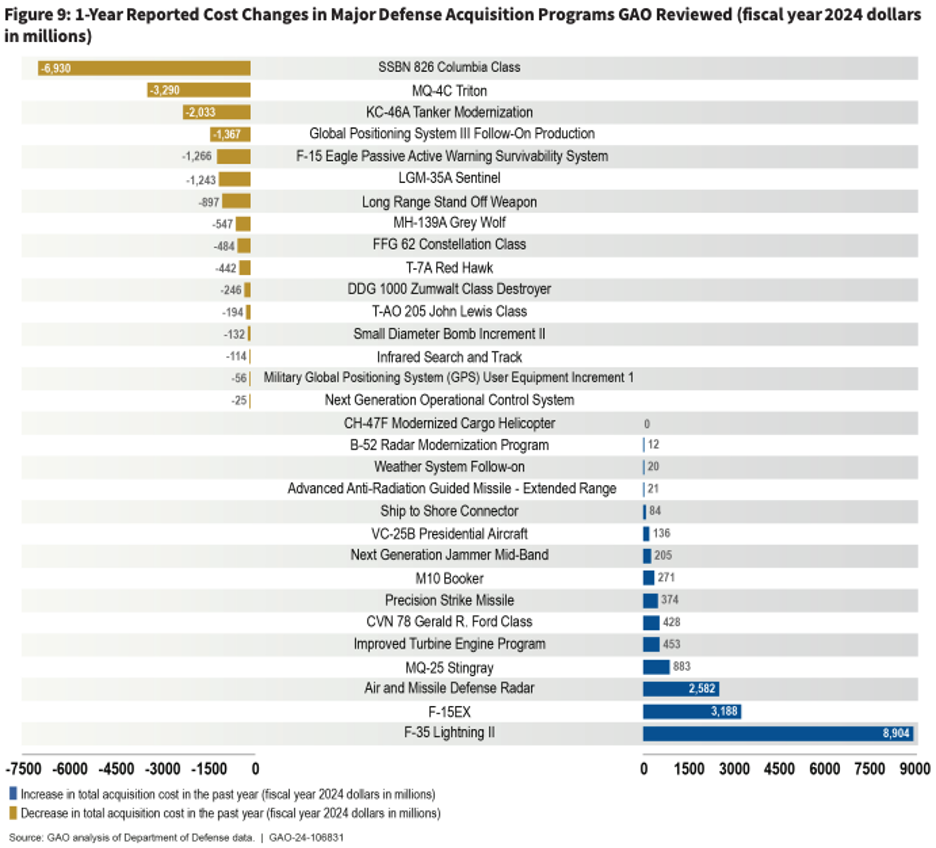
Here are last year’s MDAP cost changes, per GAO:
And here are last year’s major program delays, also courtesy of GAO:
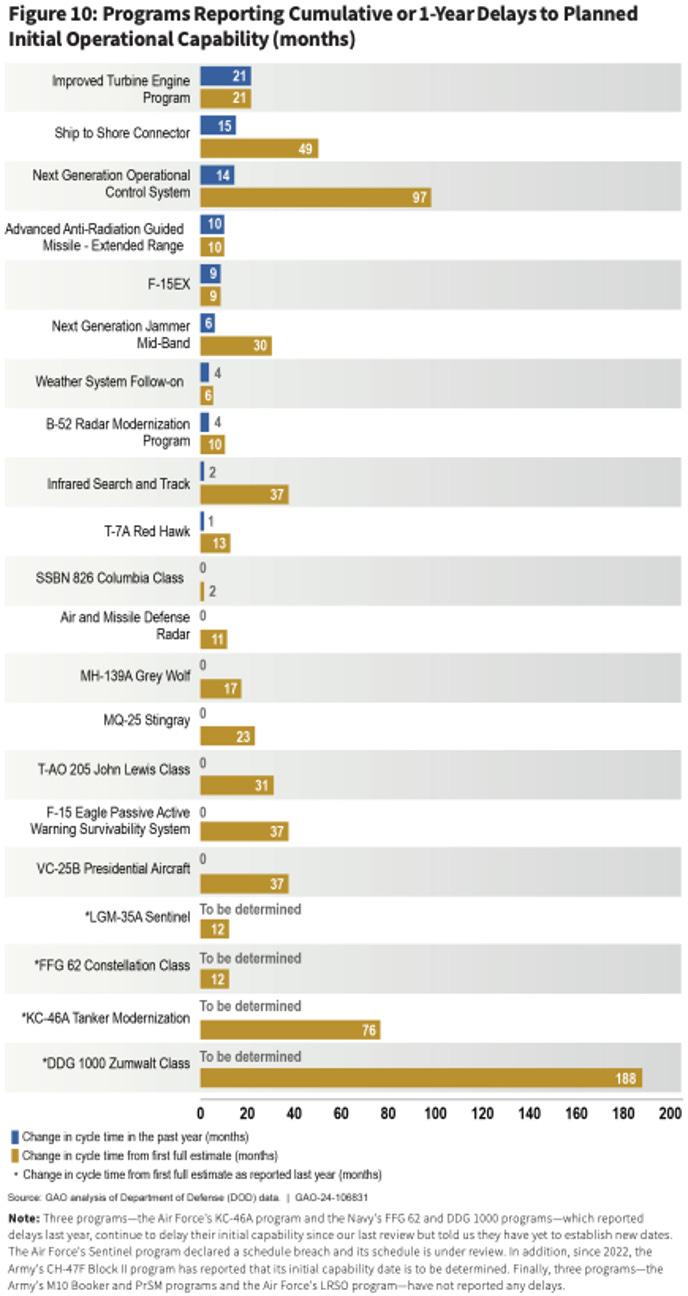
The more complex the system, tech, and program, the harder it is to correctly plan its build. Navy warships and submarines – I’d argue these are the most complex weapons platforms – are largely behind on budget and schedule. Some of this is because of inflation. Some of it is because we got to hooked on trying to be “right” about the original plan.
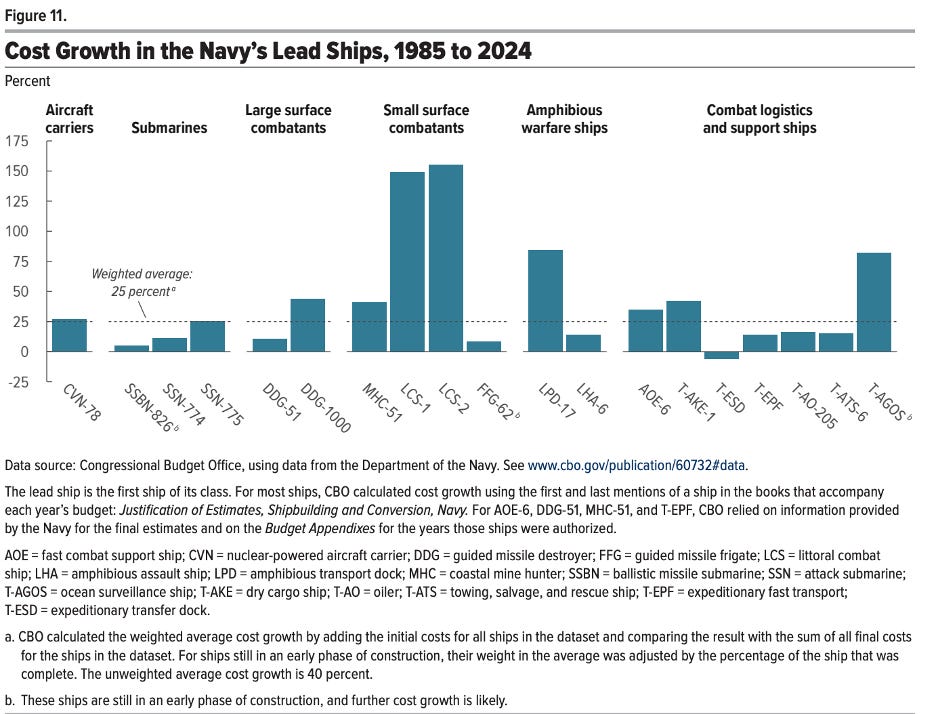
Before analyzing the weapons programs themselves, it is essential to remember a violent tension that will never retreat. Planning exactly how to build complex, new technology is very imprecise. There will always be cost and schedule discrepancies that invite oversight – oversight that may decide to cancel the program. However, the cost and schedule discrepancies alone should not drive a decision on whether to cancel the program. Last, planning should be thoughtful, and strive for accuracy.
The tension: cost and schedule are the best indicators of underperformance, but they’re also always wrong.
So what programs should get canceled?
Reading the executive order in detail, cost and schedule overruns of 15% are the criteria that invite program review, but not in themselves criteria to get canceled. The overall intent of the executive order: deliver great capability to warfighters. A new drone air defense system or logistics platform that is 16% behind but totally irreplaceable will probably not get canceled. Weapons procurement is a very political process, so media scrutiny, public narrative, and congressional attention matter a lot too.
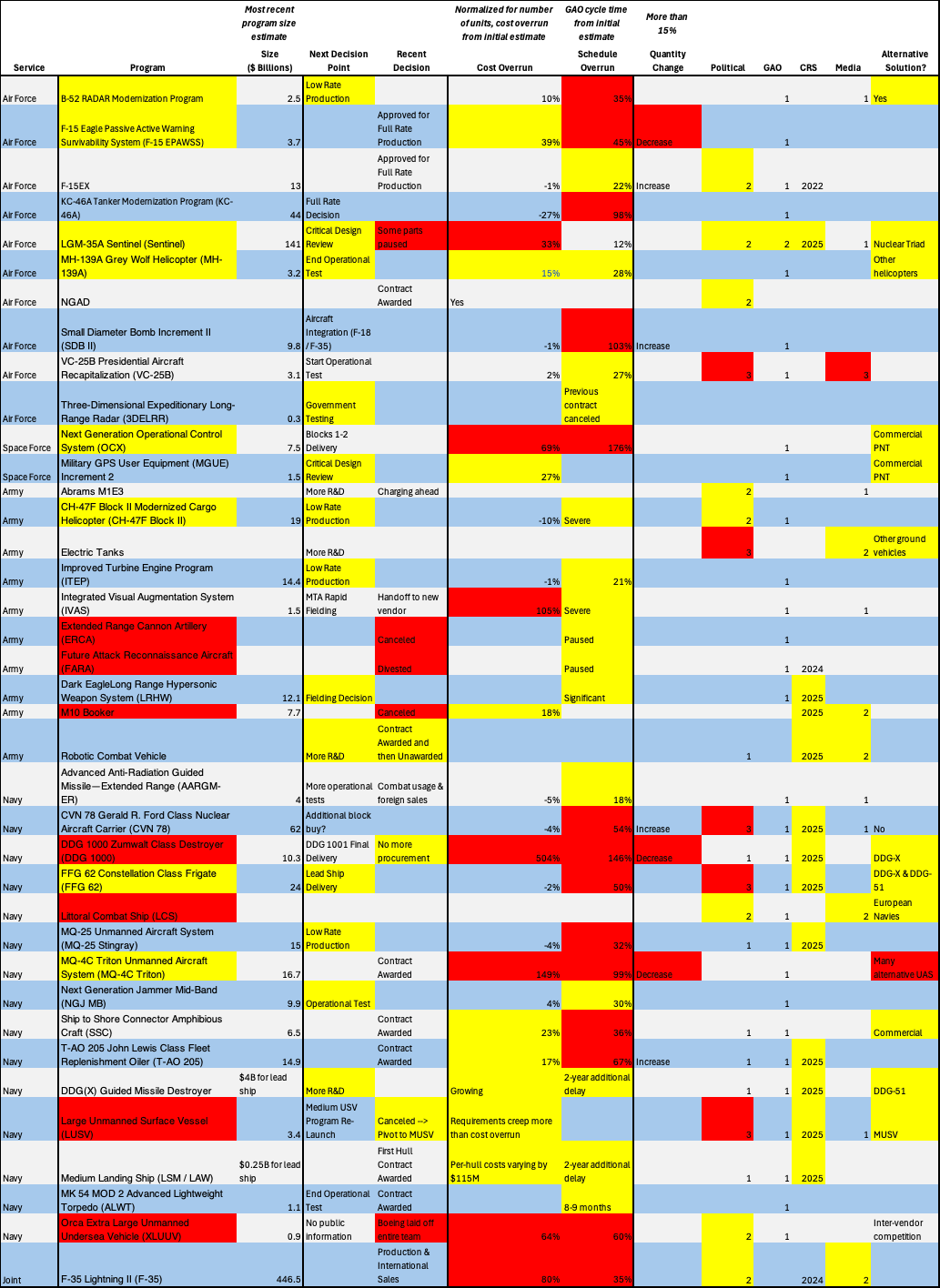
I’ll use 11 criteria to compare programs apples to apples, and predict which might face the axe. Almost all my baseline data comes from the GAO’s fantastic annual weapons system report. Where it deviates from the report, I use more recently published selective acquisition reports and news headlines. This is a good moment to caveat that much of that data is a year old, since we’re due for 2025’s report.
1 - Size ($ Billions) – How much money will be spent on this program over its life. For early R&D programs, sometimes we only know the lead platform cost, or how much has been sunk into it.
2 - Next Decision Point – What’s the next decision point for this program? If they’re close to a production decision, but the program is underperforming or the tech outdated, that’s a great program to kill. If they’re waiting on delivery of the final production platform, killing the program won’t save much money.
3 - Recent Decision – What was the most recent decision made about this program? Can this program be stopped, turned around? Are senior leaders gaining or losing confidence in this program?
4 - Cost Overrun – Normalized for number of units, cost overrun relative to initial estimate at program start.
5 - Schedule Overrun – GAO cycle time from initial estimate
6 - Quantity Change – Increase or decrease (greater than 15%). Programs that have added units likely have very strong warfighter or congressional support, if not both.
7-9 - Political, GAO, and Media
3 = maximum scrutiny
2 = serious scrutiny
1 = some scrutiny
These are subjective measures based on me reading oversight reports and googling each program. Please drop a comment if I’m wrong.
10 - CRS – When was the last Congressional Research Service report on this program
11 - Alternative Solution – Is there a viable alternative to solve this problem or provide this capability?
What it Takes to Kill a Major Defense Acquisition Program
“We will DOGE ourselves” Army leaders announced recently. They would much rather wield a scalpel now than risk outsiders smashing Thor-style through their budget and force structure later. The Army and Navy have cancelled several programs recently, offering nice examples of what dying programs look like.
Already Cancelled or Paused
Extended Range Cannon Artillery (ERCA)
Future Attack Reconnaissance Aircraft (FARA)
M10 Booker
DDG 1000 Zumwalt Class Destroyer (DDG 1000)
Littoral Combat Ship (LCS)
Large Unmanned Surface Vessel (LUSV)
Extra Large Unmanned Undersea Vessel (XLUUV)
Hypersonic Air Launched Offensive (HALO)
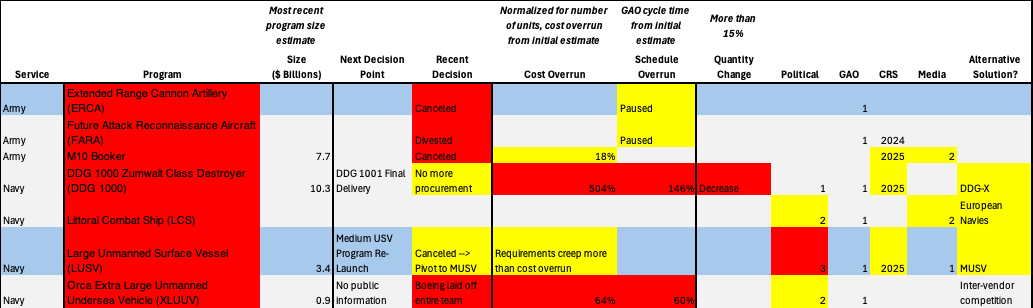
Some of the headlines from these programs add color. Looking at each, the primary indicator of cancellation wasn’t cost or schedule overrun – aircraft carriers and submarines are notoriously slow and expensive to build – but bad stories. Their tech fell behind battlefield reality, their execution fell behind program expectations, and their story collapsed. Political and media pressure + real program or tech challenges = dead program.





Three Army and five Navy programs have already been paused, canceled, or divested in recent years. The last few weeks have included a flurry of headlines from Army HQ, including notifications about specific programs. In addition to the canceled Future Attack Reconnaissance Aircraft, M10 Bookers, and Artillery, Army has publicly pressed reset on several other programs, such as the Robotic Combat Vehicle.
The Navy has been much less forthcoming. DDG 1000 and Littoral Combat Ship are still dying slow, expensive deaths over decades. The Navy’s large surface and undersea drone programs have both been in death throws, but Navy has not formally acknowledged a change for either program. The Navy did quickly cancel its HALO hypersonic missile program, however. Less than two years old, it was killed in the cradle. Does HALO sound like a failure? I would argue it was a decisive way to save a lot of resources.
The Power Rankings – Top 10 programs to cancel
I only looked at major programs (MDAPs and MTAs) on GAO’s annual assessment list. It’s possible that other programs are troubled, but they can’t be that troubled if they’re not being publicly dressed down by GAO or Congress. To make my list, a program had to be 15% behind schedule or 15% over cost.
8 programs and 2 types of programs that don’t point to a specific MDAP.
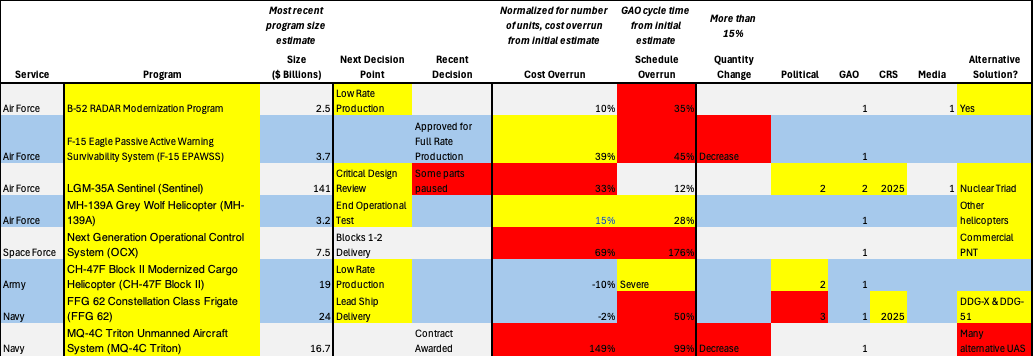
10. MH-139A Grey Wolf Helicopter (MH-139A)

Cancellation likelihood: low but non-zero
Why it would get cancelled: It’s currently in testing, a great time to cancel a program before production ramps up and big money gets committed. Some of its missions (e.g. VIP transport) could be accomplished with commercial alternatives. Secretary of Transportation Duffy last week blasted generals for over-using their personal helicopters “take a taxi or Uber.”
15% over budget
28% behind schedule
Alternatives: other helicopters
This might be the easiest Air Force program to cancel
Why it wouldn’t get cancelled: It could be a good sacrificial lamb, but it isn’t really symbolic of the core problem with MDAPs
Only slightly underperforming.
Only $3.2B
9. F-15 Eagle Passive Active Warning Survivability System (F-15 EPAWSS)

Cancellation likelihood: low but non-zero
Why it would get cancelled:
39% over budget
45% behind schedule
Past budgets already cut the quantity ordered
Why it wouldn’t get cancelled:
Recently approved for full rate production
No clear alternative
Only $3.7B
8. MQ-4C Triton Unmanned Aircraft System (MQ-4C Triton)

Cancellation likelihood: low but non-zero
Why it would get cancelled: At a moment where overpriced RQ-&-MQ-XX drones built for the global war on terror are getting shot down every few weeks over Yemen, there are many alternative unmanned aerial systems. Battlefield tech has left this platform behind & program officers have not kept it on track.
149% over budget
99% behind schedule
Past budgets already cut the quantity ordered
$16.7B is a nice size. Real budget savings but not big enough to hit GDP
Why it wouldn’t get cancelled: Joint Force needs maritime patrol and sensing that this platform deploys. It would make more sense to cancel a big Air Force drone program.
Recent contract award suggests this program will survive
7. B-52 RADAR Modernization Program

Cancellation likelihood: low but non-zero
Why it would get cancelled: Air Force acknowledges it’s looking for alternatives, which could drive program cancellation or a simpler reset
10% over budget
35% behind schedule
Upcoming decision point for low rate production is a good time to cancel
There seem to be alternative RADARs, and this program is starting to get media scrutiny
Why it wouldn’t get cancelled:
Only $2.5B mean sit isn’t much savings
6. LGM-35A Sentinel (Sentinel)

Cancellation likelihood: low but non-zero
Why it would get cancelled: Cancelling ICBMs as a leg of the nuclear triad would be a historic and emphatic decision. It would send a message to the Pentagon and political leaders that no program is safe. This decision could come only from POTUS.
33% over budget
12% behind schedule
Heavy political and GAO scrutiny, media attention growing
There are two other legs of the nuclear triad. They’re probably both more effective and more multi-mission than this one.
$141B – this program is so large and expensive that its 33% cost overrun could pay for the entire previous four programs combined. (Not their cost overruns, the entire programs)
With a design review coming up, production not yet started, and some parts of the program already paused, today is a great day to cancel the program.
Why it wouldn’t get cancelled: Any program this large has a very powerful political constituency. Republican senators in plains states will defend their ICBM bases to the last man, and aerospace primes that make the missiles are surely already producing antibodies.
I don’t have any quantitative arguments that it shouldn’t be canceled. This would be a political decision.
5. Next Generation Operational Control System (OCX)

Cancellation likelihood: moderate
Why it would get cancelled: The story of why this program should be scrapped is strengthening
69% over budget
176% behind schedule
$7.5B would be some nice savings
There seem to be alternatives for this program
No recent decisions that double down on the program or suggest it is alive and well
Why it wouldn’t get cancelled:
Space Force has generally run a pretty tight ship procuring tech like this, and may be given a longer leash than other services
4. Big, expensive, GWOT-era drones

Cancellation likelihood: high
Why it would get cancelled:
Large, expensive drones are getting shot down every month over Yemen. Some counts claim 22 have gone down over the Middle East, most over Yemen in the last two years.
If they don’t work over Yemen, they’ll be useless in INDOPACOM against longer-range Chinese surface to air missiles with much sharper seekers and over-the-horizon targeting support
Ukraine, Azerbaijan, Sudan, Yemen, and every active conflict on the planet has supercharged drone tech development. Most US drone programs of record were designed decade(s) before these lessons.
Why it wouldn’t get cancelled:
INDOPACOM needs sensor-hours and risk-worthy over-the-horizon targeting & patrol
Aside from the Navy’s MQ-4 Triton, no GWOT-era ISR drones made the GAO list of troubled programs. Although they’re too expensive for the force architecture we need, they’re not too expensive for their (large) program budgets.
3. CH-47F Block II Modernized Cargo Helicopter (CH-47F Block II) or another helicopter
Cancellation likelihood: moderate (or another helicopter)
Why it would get cancelled: This would be a nice big helicopter program to sacrifice at a time where helicopters are struggling on battlefields
37% over budget
Severely behind schedule
$19B = nice savings
Upcoming low rate production decision makes it good timing to cancel
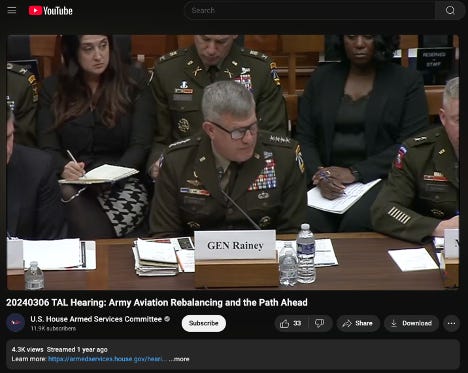
Growing political scrutiny – General Rainey having to testify on the Hill about this and other Army aviation platforms does not suggest high confidence in such programs.
Why it wouldn’t get cancelled:
Heavy lift logistics is a unique capability without a clear commercial alternative
Army has done a pretty nice job self-DOGEing and seems to really want this unique heavy lift capability
Finding another helicopter program to cancel, such as the Air Force transport that could be replaced by Uber, might protect CH-47.
2. FFG 62 Constellation Class Frigate (FFG 62)

Cancellation likelihood: high
Why it would get cancelled:
Cost overrun:
Although Navy hasn’t acknowledged cost overruns, the ship’s requirements creep is driving up future cost per ship
CRS & CBO analysis show 17-56% cost growth, relative to Navy forecasts.
50% behind schedule. This program still has years of design work, holding up lead ship construction and delivery.
It’s the obvious Navy program to cancel at a moment of severe shipbuilding anxiety, and the timing is good pre-serial production.
Navy still likes destroyers as conventional surface combatant alternatives, and can plough more effort into DDG-X and unmanned ship development with Frigate savings
$24B is great top line budget cost savings
Every type of political, media, and oversight scrutiny is growing
Why it wouldn’t get cancelled:
The Navy really does need some $1B ships so it doesn’t have to build so many $2-14B ships(?)
1. More Consultants
Cancellation likelihood: high
Why it would get cancelled: From Booze Allen to McKinsey, consulting contracts are the easiest Pentagon spending to cut. They’re expensive, not essential, and easy political punching bags.
Why it wouldn’t get cancelled:
Personnel cuts in the Pentagon make some offices want consultants (e.g. outsourced labor) even more, to help manage processes typically run by government personnel
Consultants can actually be helpful trimming org charts because they have different incentives than internal personnel. They deserve some credit for helping the Army self-DOGE
The Top-10 At Risk Programs:
Consultants
FFG 62 Constellation Class Frigate (FFG 62)
CH-47F Block II Modernized Cargo Helicopter (CH-47F Block II) or another helicopter
Big, expensive, GWOT-era drones
Next Generation Operational Control System (OCX)
LGM-35A Sentinel (Sentinel)
B-52 RADAR Modernization Program
MQ-4C Triton Unmanned Aircraft System (MQ-4C Triton)
F-15 Eagle Passive Active Warning Survivability System (F-15 EPAWSS)
MH-139A Grey Wolf Helicopter (MH-139A)
The Survivors – Other MDAPs & MTAs under GAO Scrutiny with 15% overage
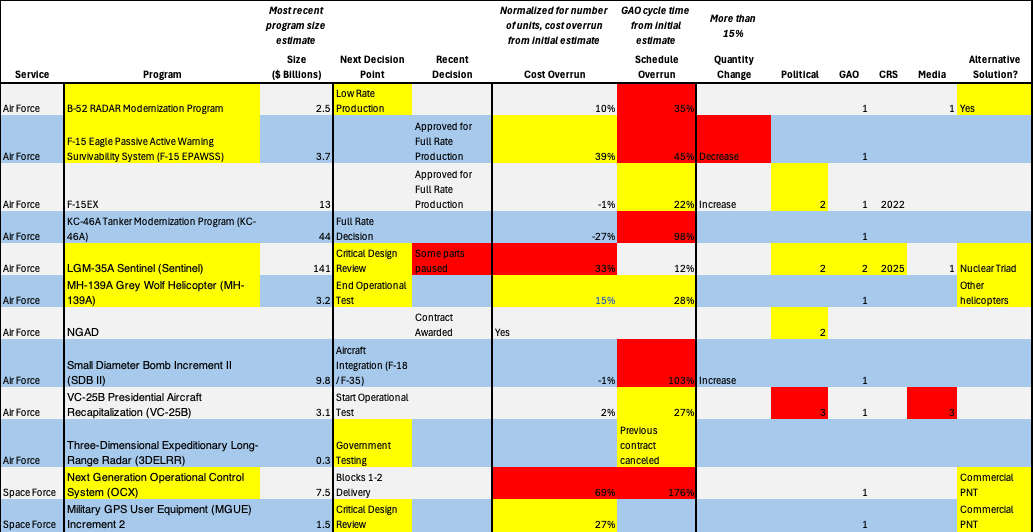
Air & Space Force Programs
F-15EX – President Trump recently announced more F15s alongside Michigan’s governor, so this program is likely safe.

KC-46A Tanker Modernization Program (KC-46A) – it’s behind schedule, but coming in under cost at a moment where the joint force really needs refueling to keep combat aircraft flying long distances in INDOPACOM.

Small Diameter Bomb Increment II (SDB II) – it’s behind schedule, but coming in affordable per unit. Congress added more budget for it recently and it’s now being used successfully in real combat operations. With political support and warfighter adoption, this program is likely safe.

VC-25B Presidential Aircraft Recapitalization (VC-25B) – President Trump has pressured Boeing to fix this program, but there are really no alternatives.

Three-Dimensional Expeditionary Long-Range Radar (3DELRR) – Air Force & RTX botched first contract —> IG investigation and cancelled contract —> new contract with Lockheed seems to be on track

Military GPS User Equipment (MGUE) Increment 2 – With cost piling up and the potential for commercial PNT alternatives, this program should not be considered safe. However, OCX is probably a better sacrificial lamb for Space Force because it would free up much more top line budget.

Army Programs
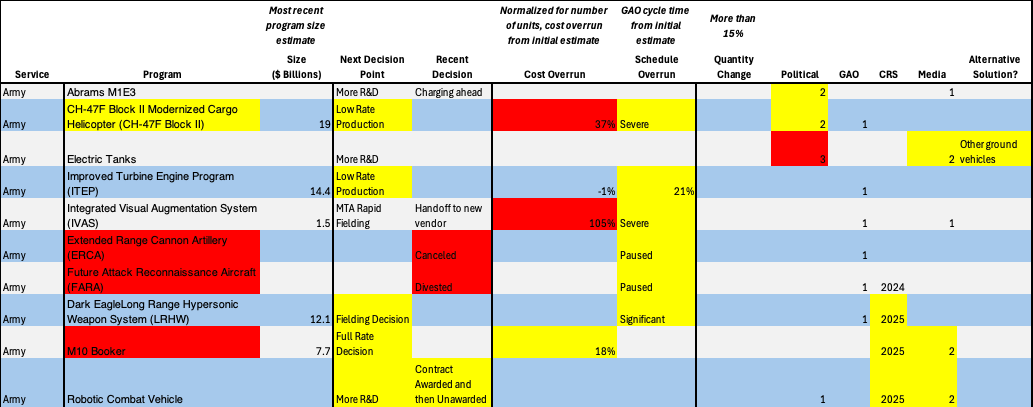
Electric Tanks – There has been political commentary about killing electric tank programs, but I couldn’t find any actual electric tank programs, so not sure how to cancel these. *The only program I included not tracked by GAO
Improved Turbine Engine Program (ITEP) – This program is a bit behind schedule, but isn’t causing budget issues and doesn’t seem to have a serious alternative.

Integrated Visual Augmentation System (IVAS) – This program is very jacked up on cost and schedule, but the Army and Microsoft recently brought Anduril on to right the course in a high visibility handoff. Anduril probably has about two years of grace period to prove they can fix it.

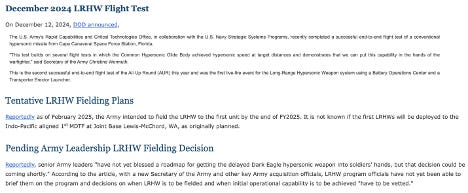
Long Range Hypersonic Weapon System (LRHW) – Hypersonics are very in these days. If flight tests go well this program should be fine. Effectively, it’s on its own schedule, not on the White House’s 90-day review track.
Robotic Combat Vehicle (RCV) – The Army just canceled a contract for this program and is pressing reset to bring in more competitors. Since this is the Army’s flagship uncrewed ground vehicle program and UGVs are proving highly effective in Ukraine, it can survive more R&D turbulence than most programs.

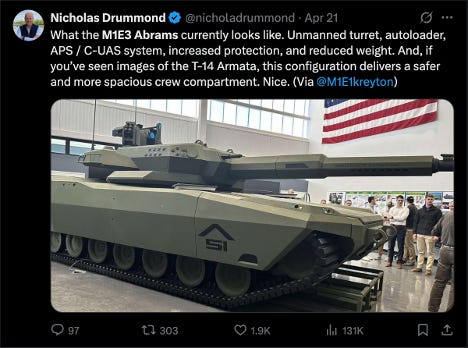
Abrams M1E3 – this program didn’t even make the GAO scrutiny list, but has received some media scrutiny, so I included it. It looks like it will survive.
Navy & Joint Programs
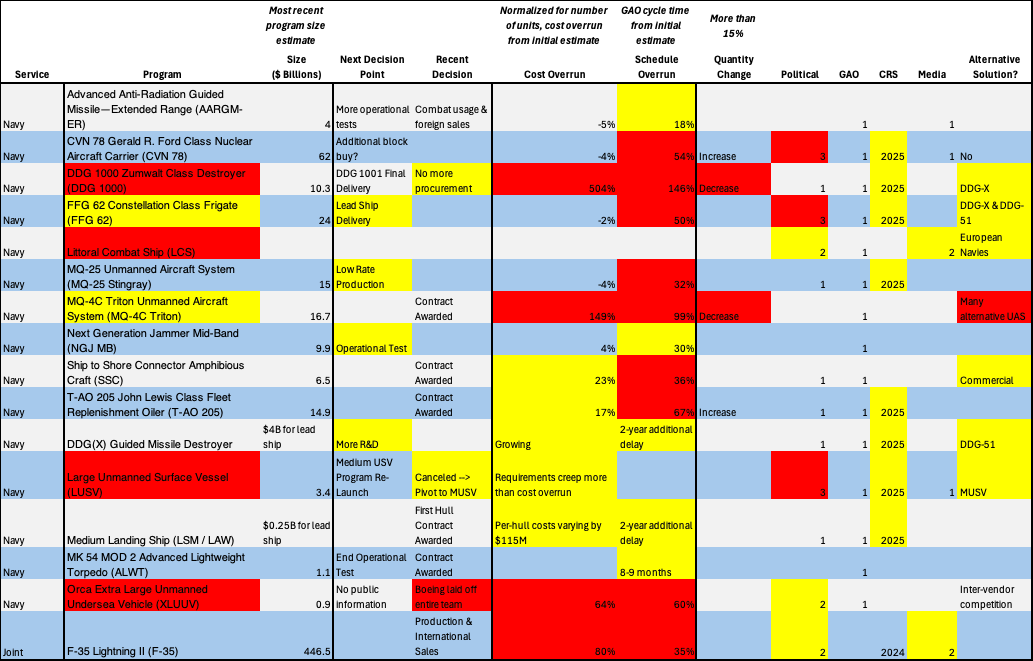
Advanced Anti-Radiation Guided Missile—Extended Range (AARGM-ER) – Although it’s a bit behind schedule, it doesn’t have budget problems. It’s also being used in combat and sold to foreigners. It will survive.

CVN 78 Gerald R. Ford Class Nuclear Aircraft Carrier (CVN 78) – The political constituency protecting aircraft carriers is too powerful to threaten the program, despite wild expense. A debate about the potency of carriers will always rage, and will only be settled in wartime.
MQ-25 Unmanned Aircraft System (MQ-25 Stingray) – This is the Navy’s flagship uncrewed aviation program. It’s taken way too long, but is set to fly this year and is not breaking the budget.

Next Generation Jammer Mid-Band (NGJ MB) – This program is a bit behind schedule, but needs to get through operational testing to make an informed cancellation decision. Recent program activity suggests it’s healthy and safe.

Ship to Shore Connector Amphibious Craft (SSC) – Congress just told the Navy to buy a bunch more of these, and they’re built by a very powerful political constituency. Also, people seem pretty fired up about contested logistics in INDOPACOM.

T-AO 205 John Lewis Class Fleet Replenishment Oiler (T-AO 205) – Congress just purchased more of these too. They’re the backbone of the Navy’s combat logistics fleet and will not be canceled.

DDG(X) Guided Missile Destroyer – DDG-1000 and Frigate – the Navy’s latest two attempts to build new surface combatants have gone so badly that this program is the Navy’s best bet to get to a 21st century multi-purpose warship. I expect some type of reset on DDG(X) since it’s well over cost and schedule, but even if they cancel the program and kick off a new one, it would effectively be a reset.
Medium Landing Ship (LSM / LAW) – The Navy & Marine Corps are moving out on this capability and trying a commercial design with Bollinger. This follows multiple resets and comes at a moment where the Marine Corps is desperate for logistics platforms, but lacks alternatives.

MK 54 MOD 2 Advanced Lightweight Torpedo (ALWT) – These torpedoes seem far too expensive, but Congress just added lots of money for torpedoes in reconciliation. Ammo designed to schlip PLA-N amphibs in the Taiwan Strait is critical. Don’t expect this program to get cancelled, but do expect Navy to find some cheaper UUV & torpedo options.

F-35 Lightning II (F-35) – It sure is expensive, but it’s the backbone of the joint force today, a flagship of US aerospace exports, and perhaps the most politically insulated program in the history of the military industrial complex.
Conclusion – What to Watch
The Army is dutifully unsubscribing from ineffective major programs, and modernizing its force. Whether Air Force and Navy antibodies can protect ICBMs and Frigates – this outcome will decide what history remembers from today. Although this piece may seem like a spicy attempt to stir discussion about specific programs, the true significance is about the defense acquisition and capability development process.
Many taxpayer investments are not delivering for warfighters. Tech from battlefields around the world is showing that capabilities will evolve faster than bureaucratic plans to develop them can formulate. Whether the political process can impose accountability on the Air Force and Navy - and help them prepare their processes for the wars to come - that is the question.

The entire list of troubled programs in one table
One item to nitpick is the “take the hill” analogy and its conclusion:
“Plans are wrong. This is why combat units plan quickly, and move out, knowing the plan will be wrong. Acquisitions bureaucrats try to get the plan right. But they never will, especially when inventing new tech.”
While not the point of your article, this isn’t accurate and detracts from the brilliance of the rest of the piece. Yes, plans can change in tactical scenarios, but the vast majority of the time they generally remain similar enough. Sometimes plans are done in 5 minutes in sand, sometimes they are done over months or years with singular focus. The most important ones are the latter. Knowing the difference of when each is appropriate is key. Also, important to note that units are able to function effectively in dynamic battlefield conditions first because of preplanned contingencies and second because of ingrained TTPs and SOPs that were part of deeper institutional planning. Planning and training are arguably the most vital elements of any combat unit’s success. I think the point you’re actually making is about the ability to plan quickly, remain flexible, and be adaptable, which I wholeheartedly agree with and believe can be more effectively adapted to acquisitions.
Excellent article.